Reverse Automation: Start With the Outcome, Then Work Backward

Traditional automation asks how to codify the steps. Intelligent automation asks how to achieve the goal.
I want to rewire how we think about automation.
That does not mean throwing out scripts, robotic process automation, machine learning, Power Automate, UiPath, or any of the other tools that have saved organizations thousands of hours and millions of dollars. Those tools work. We know how to use them, and they remain essential.
But generative AI gives us another path to mature automation — one that does not have to begin with scripting the first manual step.
I call that path Reverse Automation.
Instead of beginning with the work and asking, "How can I automate these steps?", Reverse Automation begins with the value and asks, "What outcome are we actually trying to produce?" Once that outcome is clear, we work backward, progressively automating the reasoning, preparation, coordination, and data movement required to achieve it.
This is more than a technical difference. It is a philosophical one.
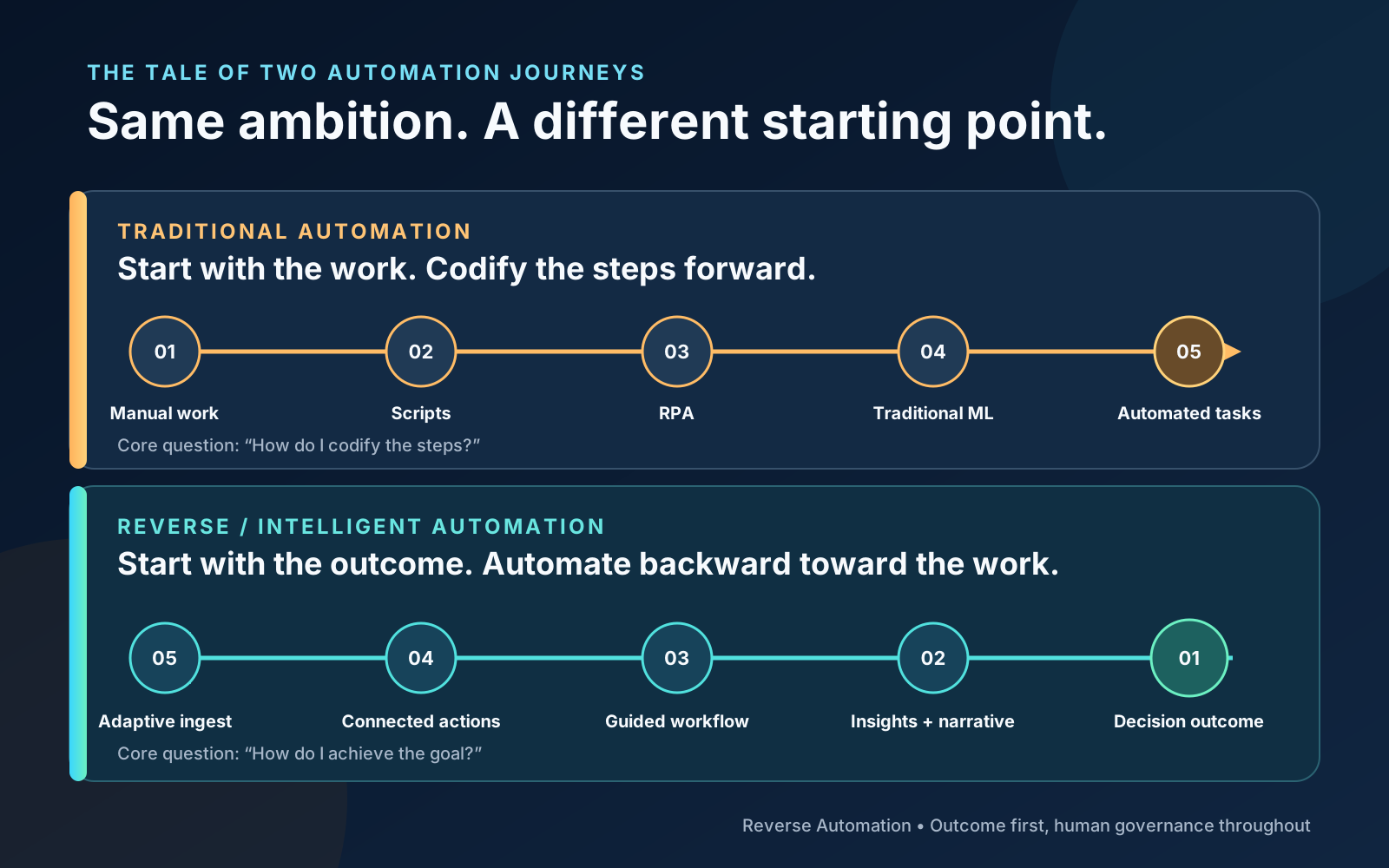
Traditional automation asks: "How do I codify the steps?" Reverse Automation asks: "How do I achieve the goal?"
Meet Jordan, the spreadsheet hero
Consider Jordan Rivera, an operations reporting lead responsible for a weekly KPI report. Every Monday by 9:00 a.m., leadership needs a standardized workbook and a narrative summary. The incoming material is messy: Excel files, CSVs, PDFs, screenshots, email attachments, and SharePoint links from multiple regions.
Jordan is flexible. Jordan knows what a strange column means, notices when a number looks wrong, repairs broken formulas, rebuilds charts, and turns the data into a story leadership can act on.
Jordan is also the single point of failure.
The process consumes evenings and weekends. If Jordan is unavailable, the report may not happen. Worse, most of Jordan's energy goes into making the process function — not interpreting the information or enabling better decisions.
That is where both automation journeys begin. They share the same pain and the same ambition. What changes is the starting point.
The traditional path: automate the work forward
The conventional maturity path begins at the first repetitive task and moves forward.
Jordan starts with a script that finds KPI emails and extracts attachments. That is a real win: fewer downloads, less inbox triage, and more consistent staging. Then Jordan adds consolidation scripts with hardcoded column mappings. Next comes RPA to open applications, refresh Excel, click through SharePoint, and publish the report. Traditional machine learning and rules may later add OCR, validation, anomaly detection, or classification.
Each layer automates more of the process:
- Manual workflow: Outlook, Excel, human judgment, grit.
- Basic scripting: automate email and attachment extraction.
- Scripted consolidation: merge files and apply fixed mappings.
- RPA: reproduce UI actions across applications.
- Traditional ML: process unstructured inputs and apply automated checks.
This path can create enormous value. It can also create a brittle stack. Subject lines change. Columns move. A new executive assistant sends a PDF instead of an Excel file. Microsoft changes a button. A popup appears. A model meets an edge case it was not trained to handle.
Now the automation needs an automation team. Jordan is no longer only producing reports; Jordan is debugging scripts, repairing bots, managing mappings, and coordinating specialists. The organization has automated the process, but may still be spending too much effort preserving the machinery.
The reverse path: reveal the value first
Reverse Automation begins at the opposite end of Jordan's workflow.
Before automating inboxes, folders, or clicks, Jordan uploads the source material into an approved generative AI tool and asks for a leadership-ready analysis: summarize the reports, identify patterns, flag anomalies, and draft the narrative.
Day one is still manual. Jordan still collects the files. But the most valuable part of the process — the insight that helps leadership make a decision — appears immediately.
That matters. In the traditional path, intelligence is often added near the end, after the data plumbing has been built. In the reverse path, intelligence comes first. Jordan can discover what a useful output looks like before the organization invests in automating everything required to produce it.
As I described it in the Lunch & Learn, we are "working backwards from the value" — understanding the real output first, then automating the harder parts of the process behind it.
The automation develops in layers:
1. Assistive GenAI
Jordan asks for summaries, clarifying questions, comparisons, and early anomaly detection. The AI provides value, but Jordan performs the actions.
2. Augmented workflow
Jordan asks the model to extract tables from mixed formats, normalize them, combine them into a copy-and-paste-friendly structure, calculate a new field, and draft a consistent report. The prompt becomes a lightweight form of executable business knowledge — closer to a human-readable specification than a brittle mapping file.
3. Guided automation
Jordan turns the successful interaction into a repeatable multi-step workflow: ingest the files, check completeness, analyze the data, assemble the consolidated report, draft the narrative, and pause at important decision points. The human still reviews high-impact choices.
4. Agentic automation
The workflow connects to email, files, task systems, and publishing services. It plans the work, invokes tools, validates its own results, records what it did, and escalates when confidence is low. Jordan can specify the objective in natural language: generate last week's KPI report, publish it, and notify leadership.
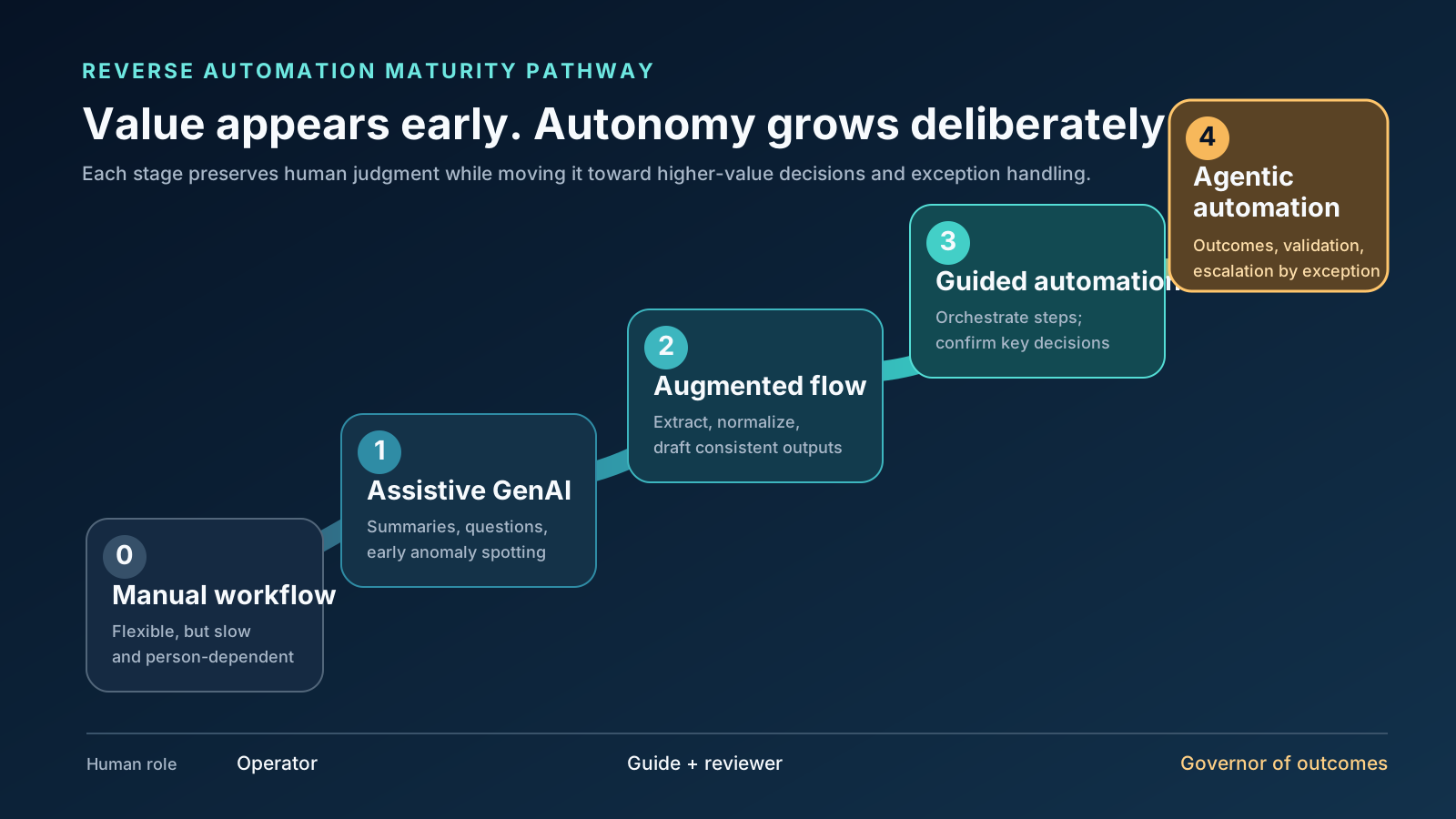
The key is that value appears early while autonomy grows deliberately. We do not need to build the fully autonomous system before learning whether the output is useful. We can prove the reasoning, the narrative, and the decision support first, then work backward into orchestration and execution.
From producing documents to governing outcomes
The endpoint is not "no humans." It is a better division of labor.
In the mature scenario, the system checks whether all regional data arrived, adapts to format changes, normalizes the inputs, evaluates anomalies, generates the narrative, and prepares the report. Confidence scoring and business guardrails determine what happens next:
- Green: the evidence and validations meet defined thresholds, so the report is published automatically.
- Yellow: the system finds uncertainty or a meaningful anomaly, presents the evidence, and asks Jordan to decide.
- Red: a critical dependency fails or a guardrail is violated, so the system escalates, preserves the work it completed, and offers a recovery path.
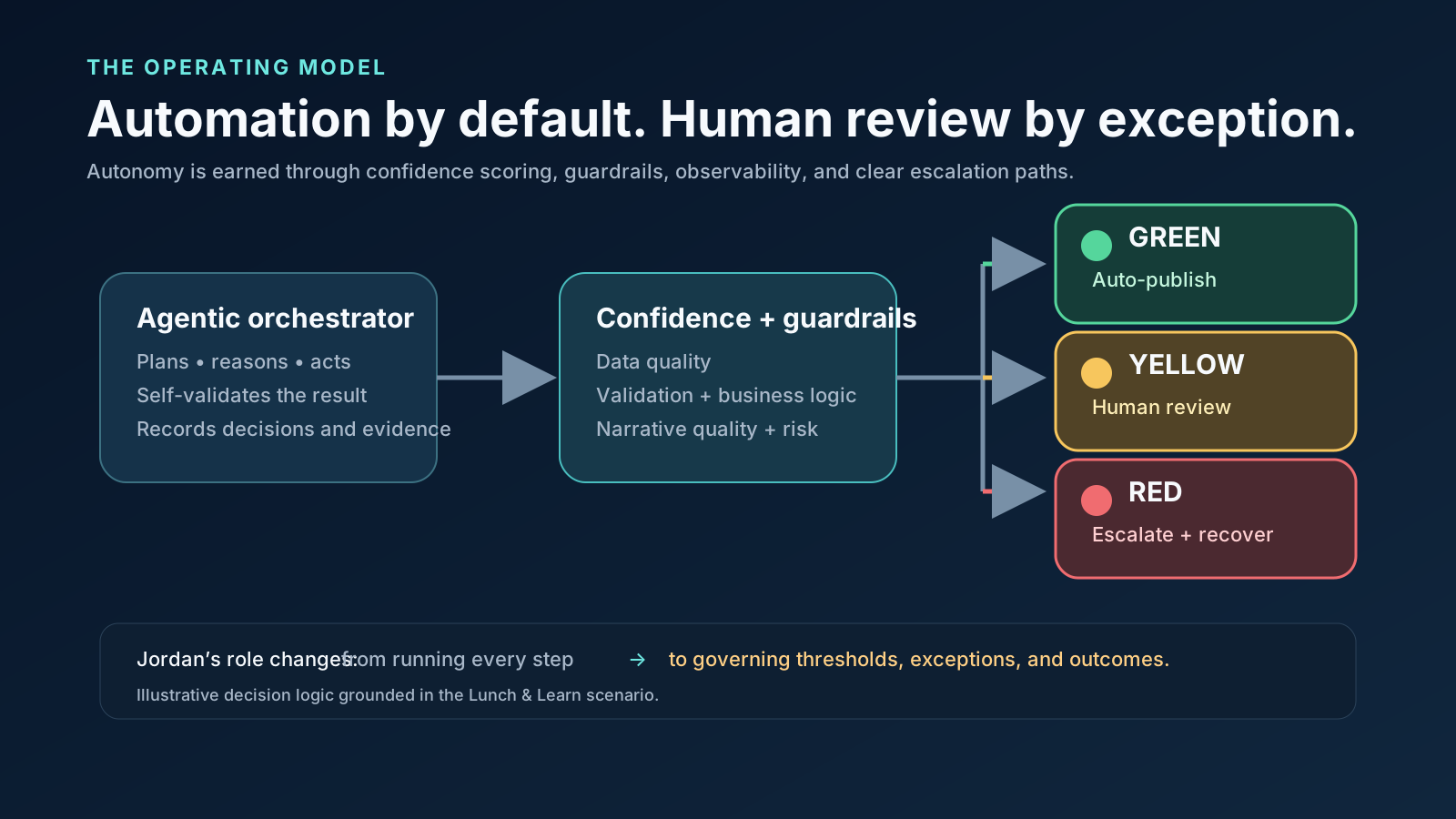
This is automation by default and human review by exception. Jordan is not removed from the process. Jordan's expertise becomes the governance layer.
That change is profound. Jordan moves from executing every step to setting thresholds, refining instructions, reviewing unusual cases, improving the system, and analyzing strategic trends. In the scenario's language, Jordan goes from being an automation firefighter to an AI governance leader.
Or, as Jordan puts it:
"I don't generate reports anymore. I govern an intelligent system that generates reports. When something unusual happens, the system knows to ask me."
Reverse Automation is not "AI everywhere"
Starting with the outcome does not mean forcing AI into every task. Some work is deterministic and should remain deterministic. A known calculation belongs in code. A stable API is better than a bot clicking pixels. A clear business rule should remain explicit and testable.
The reverse path changes the order in which we learn and design. It helps us identify where reasoning adds value, where uncertainty requires judgment, and where conventional automation can later make the proven workflow faster and more reliable.
The result is often a hybrid architecture:
- Generative AI interprets varied inputs and produces contextual narratives.
- Deterministic services perform calculations and enforce non-negotiable rules.
- Orchestration connects data and actions across approved systems.
- Confidence scoring and observability make decisions inspectable.
- Humans retain authority over high-impact, ambiguous, or exceptional cases.
That combination is more important than any single model or tool.
How to start working backward
You do not need an enterprise agent platform to begin. Start with one recurring, painful workflow and ask five questions:
- What decision or outcome creates the value? Describe what "good" looks like for the customer, operator, or leader — not what the current process produces.
- Can an approved GenAI tool create a useful first version of that outcome today? Test summaries, comparisons, explanations, anomaly reviews, or drafted communications with a human in control.
- What repeated instructions make the result reliable? Capture the expert's judgment as a clear, reviewable workflow rather than leaving it trapped in one person's head.
- Which preceding step is now the biggest source of friction? Work backward: normalize the files, retrieve the email, create the document, update the task, or publish the output.
- What must be governed before autonomy increases? Define permissions, data boundaries, validation rules, confidence thresholds, logs, review points, and recovery paths.
This approach lets a team learn at the speed of the business problem. It avoids spending months automating a process before discovering that the output is not what users actually need.
A different way to reach the same ambition
Traditional automation and Reverse Automation are not enemies. They are two journeys available to us.
The traditional path starts with a task and builds forward: script it, consolidate it, robotize it, validate it. The reverse path starts with the outcome and builds backward: reveal the insight, structure the expert workflow, connect the tools, and earn greater autonomy through governance.
Both can lead to mature systems. But the reverse path changes what we optimize first. We stop treating the existing sequence of clicks as the definition of the work. We focus on the value people are trying to create — and then design the shortest, safest, most adaptable path to produce it.
The transformation is not that Jordan disappears.
It is that Jordan finally gets to do the job Jordan was hired to do: enable decisions, not just produce documents.